Globàlium · A Short Manual
Globàlium
Edited by Jordi Berenguer Rodrigo (December 2024)
Opengea SCCL
· Creative Commons BY-NC-ND 4.0 license
1. Presentation
This manual was born of many teachers and many hours: of the workshops at Mas el Negre, since November 2021, where we have polished the model together; of patient study over these last years; and of the extraordinary people I have met along the way. The Vidabona Foundation has been its cradle; to it, and to all of them, I owe these pages.
What you now hold in your hands is a distillate: agile and clarifying. A doorway in. May you enjoy it.
2. What is the Globàlium?
The Globàlium is a map of everything. It was conceived by Lluís Maria Xirinacs i Damians (1932–2007), known above all for his courageous voice in the non-violent defence of peace and freedoms. But behind that public man there was another, more silent one, tracing an architecture of thought: the Globàlium is his most ambitious work — and, paradoxically, the least known.
Convinced that humanity needed a new way of seeing in order to overcome its conflicts, Xirinacs devoted much of his life to it. In 1997 he presented it as a doctoral thesis at the University of Barcelona. Through painstaking research and multidisciplinary synthesis, he built a geometric and linguistic model capable of ordering all human knowledge — where, he said, everything from God to an espadrille had to fit. He never conceived it as definitive, but as an ever-provisional and revisable tool. The most important thing, he insisted, was that it should be useful to us.
Just as the map is not the territory, the Globàlium is not reality either — but it is a simplification useful enough to let us understand it and move through it. We all live with unconscious mental maps, shaped by culture, history and the decisions we keep making. The Globàlium lets us chart these invisible maps, become aware of them, and order them in a multidimensional space. In this way we widen our view: we discover parts of reality we had ignored or overrated, we harmonize the extremes, and we gain fullness and perspective in everything we can know, do, hope and be.
The Globàlium can be applied to every discipline — and it even serves to invent new ones. In brief, it serves to:
Widen and clarify our vision of reality. A mental map of reality that helps us simplify complexity and see what we cannot see through the limiting lenses of our subjectivity. A map on which to order, in an intelligible way, all the knowledge we acquire throughout life1.
Facilitate dialogue and consensus. The spherical geometry of the model lets us overcome the limitations of language2 and of linear thought, integrating and harmonizing diverse points of view within a coherent structure with univocal language. This makes it a peacemaking and effective tool for facing and resolving personal and collective challenges.
Orient us and give meaning to existence, acting as a navigation chart for life. It helps us find the path towards fullness3, harmonizing the material, emotional, mental and spiritual aspects, and identifying what is essential in our life, so we can be freer and more responsible, and more courageous and loving.
Facilitate creative thinking. It structures our mind holistically so we can balance our thoughts and decisions from multiple angles, discovering how paradoxes can coexist in harmony, and exploring and discovering new spaces and new interdisciplinary relations.
3. Genesis of the model
Human beings have always sought models to explain reality globally. In Catalonia one can trace a clear historical tradition of thinkers who devoted their efforts to this. In the 13th century, Ramon Llull produced the astonishing work of the treatise Ars Magna generalis et ultima, which describes a mechanized model for understanding reality. This model used logical wheels and defined fundamental categories drawn from language. Llull's aim was to ease understanding among all human beings, whether they were Christians, Jews or Muslims. Meanwhile, from the 11th to the 13th centuries, Girona became the most important kabbalistic centre in the West. The Kabbalah too has been a significant tool for interpreting reality, in both the Jewish and Christian traditions.
We can regard Lluís M. Xirinacs as the Ramon Llull of the 21st century. Xirinacs developed his own model using the geometric figures of the sphere and the hypersphere instead of Llull's mechanical wheels. This model, which he built over the course of his life, was the structure from which he observed reality. But between Llull and Xirinacs, many other thinkers made significant contributions. In the 14th century, Ramon Sibiuda wrote Theologia naturalis, describing reality on four levels: being, feeling, thinking and living. Beyond Catalonia, Leibniz contributed the theory of monads in his Monadology. In the 19th century, Jaume Balmes wrote Criterion, Fundamental Philosophy, connecting rationalism, empiricism and religion, while Francesc Pujols developed the concept of the "General of Catalan Science" in his Pantology. In the 20th century, Ferrater i Mora introduced his Dictionary of Philosophy, Eugeni d'Ors wrote on the dialectics of seny (good sense), and Raimon Panikkar worked at the intersection of East and West. These thinkers, driven by a common spirit of integration, have helped to build a fuller and more cohesive society.
In the 21st century, Xirinacs, with his global model of Reality, the Globàlium, masterfully synthesizes all the sediment of earlier knowledge, achieving an unprecedented synthesis of wisdom. Thus, thanks to them all, today we have the good fortune to walk on the shoulders of giants. Our challenge is to gather and harmoniously integrate the whole legacy of the masters who came before, and to seize the opportunities that present reality offers in order to propel ourselves creatively towards the new challenges of the present.
4. The new paradigm
We live in a moment of confusion and fragmentation. Technology accelerates us without our knowing where to, and the essential questions — who we want to be, how we are to live together — are eclipsed by the noise. We are at the crossroads: history has brought us here to choose how to go on.
The indicators are clear: the current model is exhausted. It does not call for surface touch-ups, but for a change of structure that responds to the emerging complexity and leads us towards a viable and sustainable model. We need a new paradigm — one that orders reality and puts back at the centre the integral wellbeing of people and peoples, as well as of the nature and ecosystems that sustain us.
The Globàlium is a tool for this change. It proposes an integrating gaze: a bird's-eye view in which the person, society and the ecosystem form a single fabric. And it recovers what is essential — fullness, individual and collective.
If the invention of the wheel revolutionized movement, the Globàlium is the wheel of thought. It frees us from the thinking that opposes the extremes instead of reconciling them — the thinking that has generated so many conflicts — and invites us to think in curves: multidimensionally, with room for the complementarity of opposites.
The challenge now is to make the step from theory to practice — to integrate the study and application of global models within human culture. In this way we will have transformative tools, and a common framework of understanding.
Fortunately, every day more people and organizations are joining this transformation. The Globàlium is a promise of hope: it offers language for mutual understanding and for cooperation.
5. Globalistics
Globalistics is a new discipline: the study of the global systems, processes and problems that affect humanity as a whole, and the search for answers with models and methods capable of generating regenerative systems that integrate diversity. It is an academic effort to synthesize all accumulated human knowledge within an interdisciplinary framework that allows us to understand and manage the complexity of today's world. Although it starts from a holistic gaze, its solutions always take concrete form in local contexts: the interaction between globality and locality is an essential part of it.
Globalistics must not be confused with globalization. Globalization, as we usually understand it, is an economic-political phenomenon: the expansion of neoliberal capitalism affecting society and ecosystems on a planetary scale. More than a truly global process, it is often a colonization: the imposition of some local or regional realities upon others, making some parts dominate and exploit the rest.
True globalization would be something else: human, inclusive, grounded in a planetary consciousness that transcends particular economic and ideological interests. It would mean building a noosphere — a layer of shared, interdisciplinary knowledge — and making conscious use of technology to facilitate a social, cultural and ecological change towards a sustainable and regenerative future.
Globalistics champions the generalist gaze (knowing a little about much) as the necessary complement to expert knowledge (knowing much about little). And it distinguishes itself from two other forms we often confuse with wisdom:
Total: claiming to know everything about everything — an impossible omniscience.
Sceptical: doubting everything, knowing nothing about anything — paralysis.
Globalistics is well-directed modesty: a broad gaze that knows how to connect, without replacing the deep knowledge of the specialists.
Without Globalistics, the Globàlium would stagnate. The discipline is needed to give continuity to the model's evolution: to rethink it, reinvent it, keep it alive — from generation to generation.
6. Characteristics
We could find many characteristics that make the Globàlium unique. These are the six main ones:
Geometric. Xirinacs created two models: a minor one (spherical, 3 dimensions) and a major one (hyperspherical, 4 dimensions) — the latter being the complete one. His intuition: mental space is curved, like physical space-time. Spherical models, like the maternal womb, are peacemaking and democratizing through their perfect symmetry — every perspective can fit within a global, integrated view, without privileging any dominant axis.
Linguistic. The Globàlium gives the word a precise place in space. Each fundamental concept occupies a position — and it is this position that defines it. The model has 8 main categories (which form 4 dimensions) and up to 80 categories at the most detailed level. Thus any idea can be situated with univocal meaning, and the door opens to a shared language for inter-human understanding.
Dialectical. The categories are not islands: each has a semantic aura that blends with the neighbouring ones and converses with the opposing ones. Each concept is defined by the nearby categories and complemented by the distant ones. Thus it becomes manifest that everything is linked — and that between two points of view, however far apart, there are always infinite paths of dialogue.
Holistic. All the parts are interconnected in a whole — and each part contains the whole. Hence the ethical and peacemaking force of the model: it harmonizes reality and combats dogma; it transforms opposition into complementation, competition into cooperation. Its structure is fractal: each concept of the model contains, within itself, all the dimensions and categories. We can always go deeper into it.
Dynamic. Xirinacs described it as a closed model of constant radius. But — we add — it is also open: reformable, expandable, able to incorporate more and more categories, like someone delving into a fractal. A fractal has a limited area and a constant fundamental pattern, yet is infinite in depth. If reality is dynamic, the model must be so too. The Globàlium is therefore always provisional and revisable — practically open source, so each person can adapt it to their changing needs.
Autarkic. It is a metamodel — a model of models. It has the epistemological self-sufficiency to generate worldviews about any field of knowledge, and thereby to reform or revolutionize existing paradigms. It does not replace them: it complements them by addressing their blind spots. Hence its power to face complex problems and adapt to intellectual and operational challenges.
The innovation of the model
The Globàlium offers a representation of global reality in a relational ontological space, based on a non-Euclidean geometry. Mental space, like physical space, is curved. This is the underlying innovation: a system that lets us move between discontinuity and continuity, unity and multiplicity, simplicity and complexity — with paradoxes not as errors, but as an essential part of the process of understanding.
Far from avoiding contradictions, the Globàlium embraces them, offering a dynamic balance between terms and anti-terms that lets ideas evolve fluidly. It is not, then, a mere conceptual model: it is a new way of understanding reality — and an invitation to rethink it from a broader and more flexible perspective.
Principles and spindles
From the model, Xirinacs inferred four fundamental principles — four statements about how the parts relate to the whole:
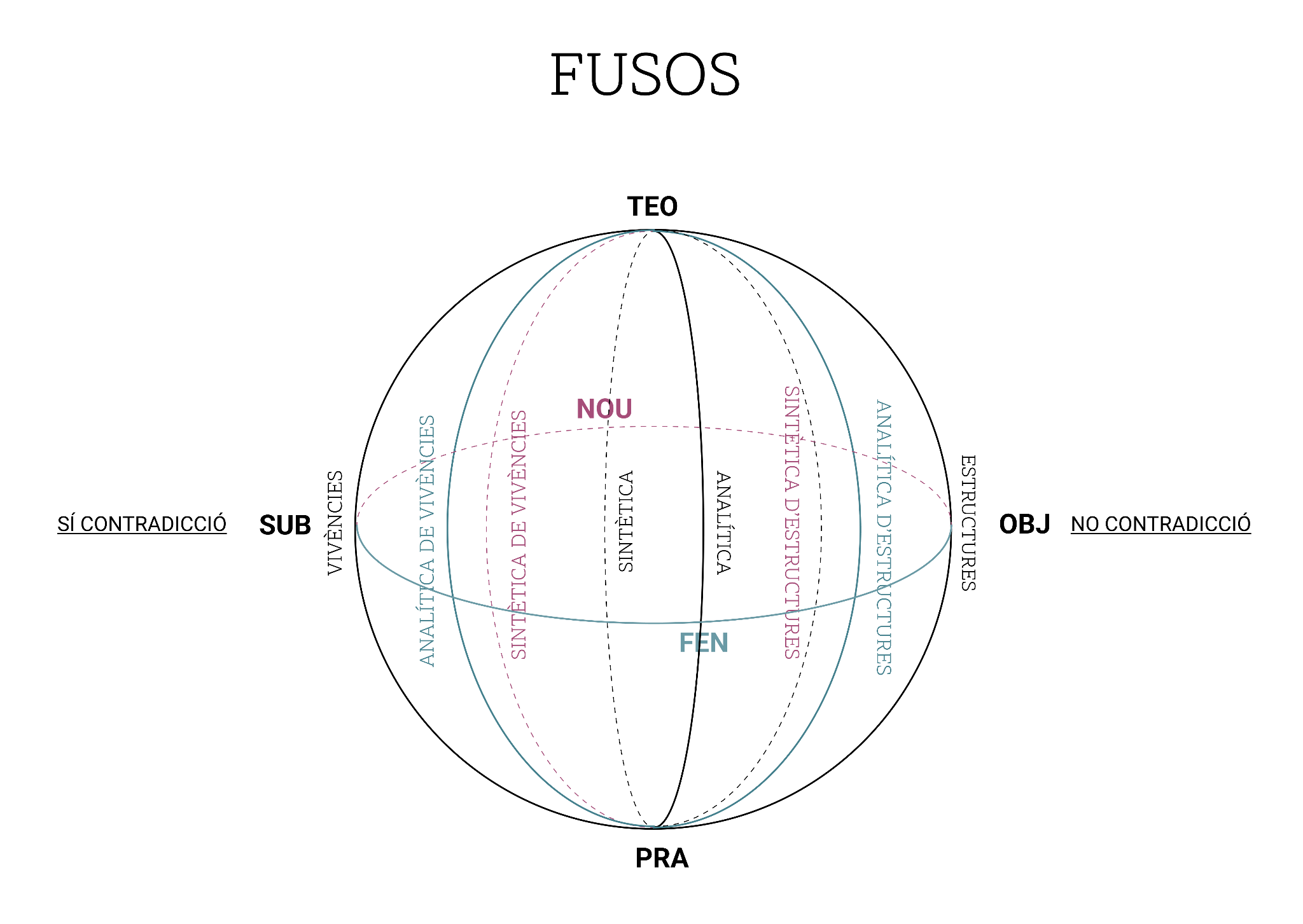
Identity: each part is itself and not another. Spindle analytics of structures (Objective-Phenomenal). Corollary: all things and people are unique and necessary.
Alterity: each part affects the others. Spindle analytics of lived experiences (Subjective-Phenomenal). Corollary: everything affects everything — we are all connected; where there is action, there is reaction.
Holicity: the whole is in each part. Spindle synthetics of lived experiences (Subjective-Noumenal). Corollary: each part potentially contains the whole — it is a microcosm of it.
Universality: the whole is the sum of the parts plus their relations. Spindle synthetics of structures (Objective-Noumenal). Corollary: the possibilities of reality are infinite — and they add value to the whole.
Identity and Universality are principles of non-contradiction (reality tends to remain constant). Alterity and Holicity are principles of yes-contradiction (reality is alive and changing).
7. Models
The Globàlium can be studied at three levels of increasing depth, according to the detail we need:
Basic general model (Fig. 1)
The simplest view. 8 fundamental points that determine 4 dimensions. It is the first step towards globally understanding how to combine, harmonize and balance the poles of the model — without excluding any dimension.
Minor model (Fig. 2)
An intermediate level. It identifies the in-between points of the 3 spatial dimensions (FEN-NOU, SUB-OBJ, TEO-PRA), reaching 26 categories. We recommend studying it before the major model. As Xirinacs presented it, it does not include the 4th dimension (Plasma-World) — which does appear in the basic general model.
Major model (Fig. 3 and Fig. 4)
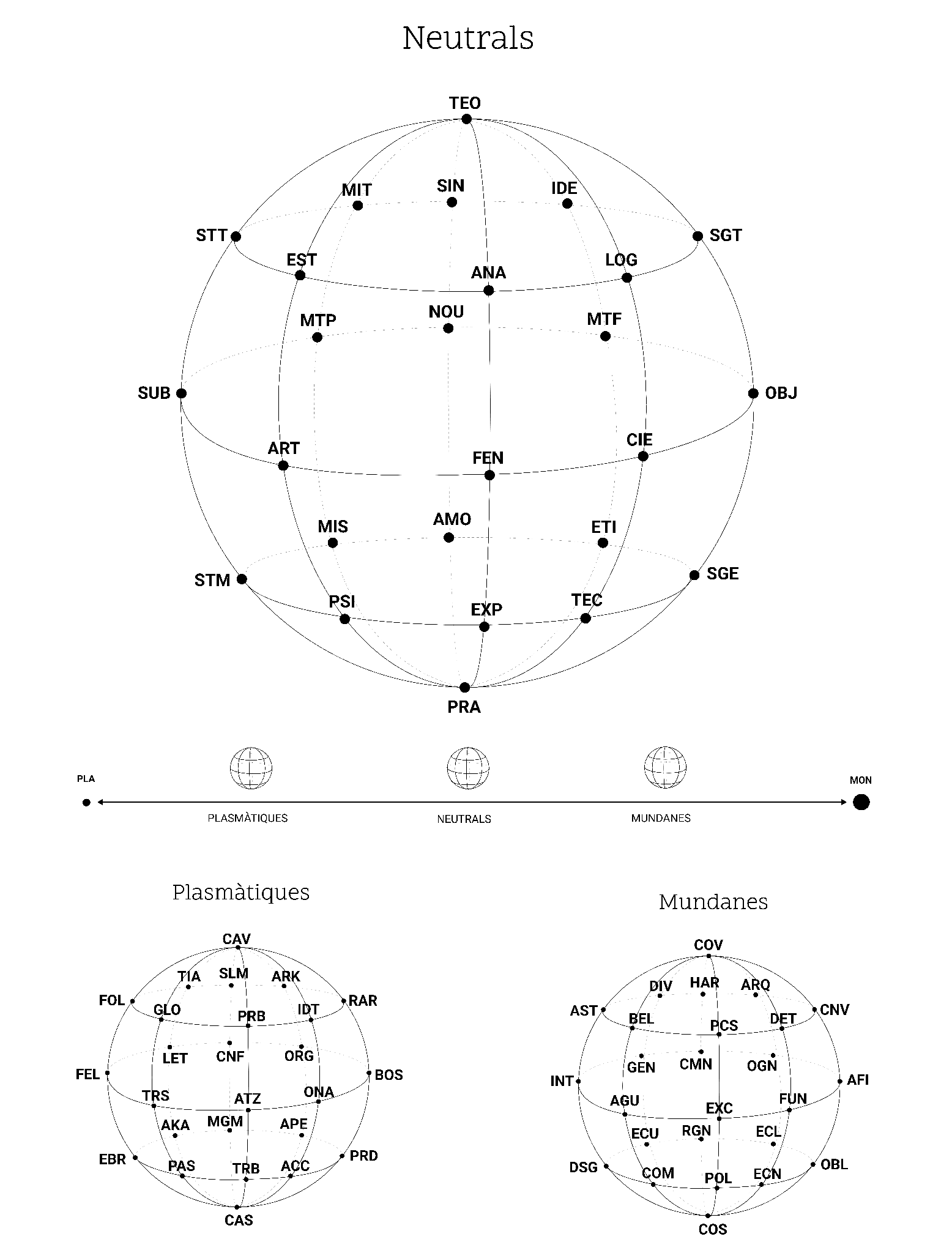
The complete model: 80 categories distributed across 3 layers — 26 plasmatic (interior), 26 neutral (axes and diagonals) and 26 worldly (surface), plus Plasma and World as centre and extreme. Fig. 3 shows it whole; Fig. 4 breaks it down layer by layer.
Fig. 1. Basic General Model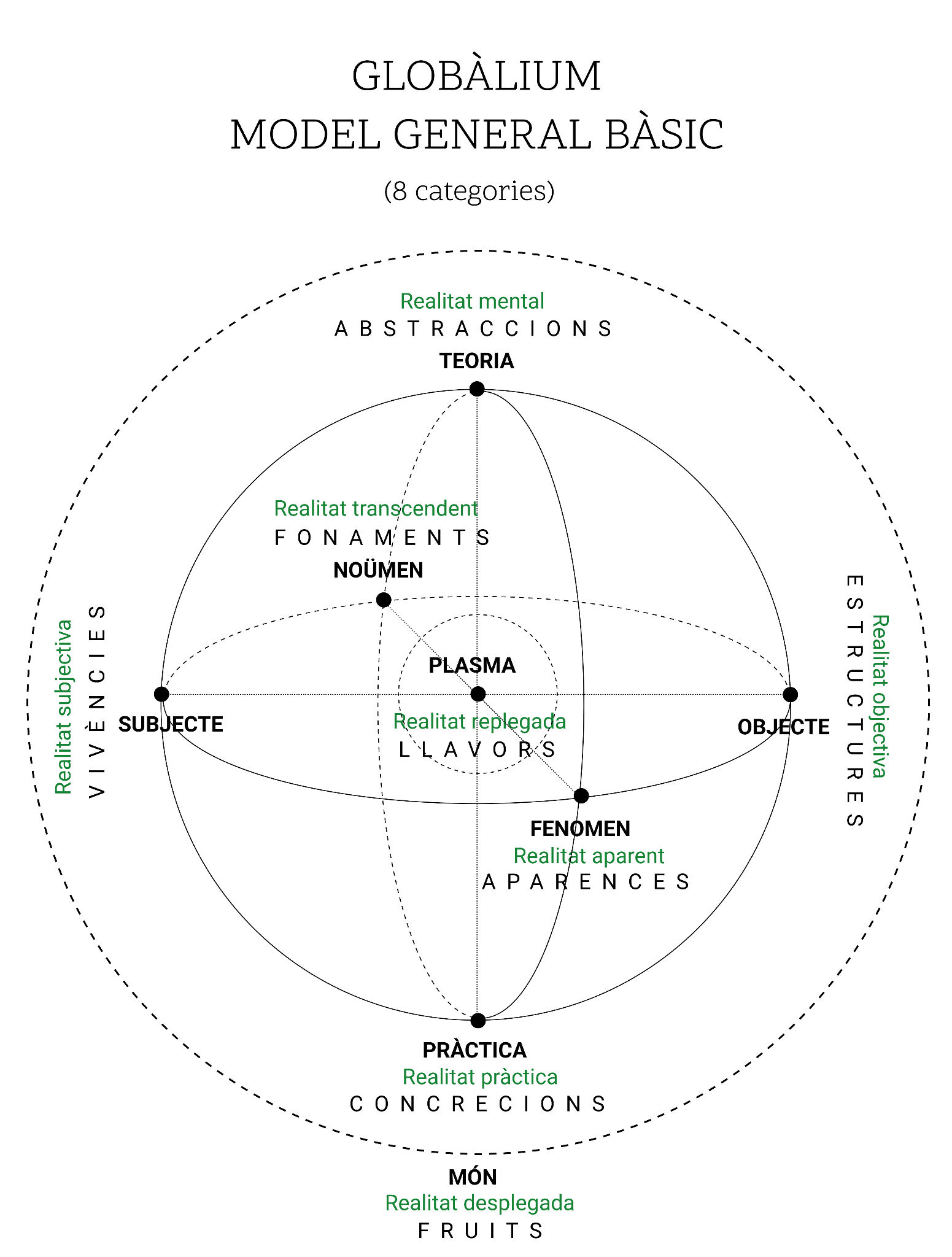
.
Fig. 2. Minor Model. 4
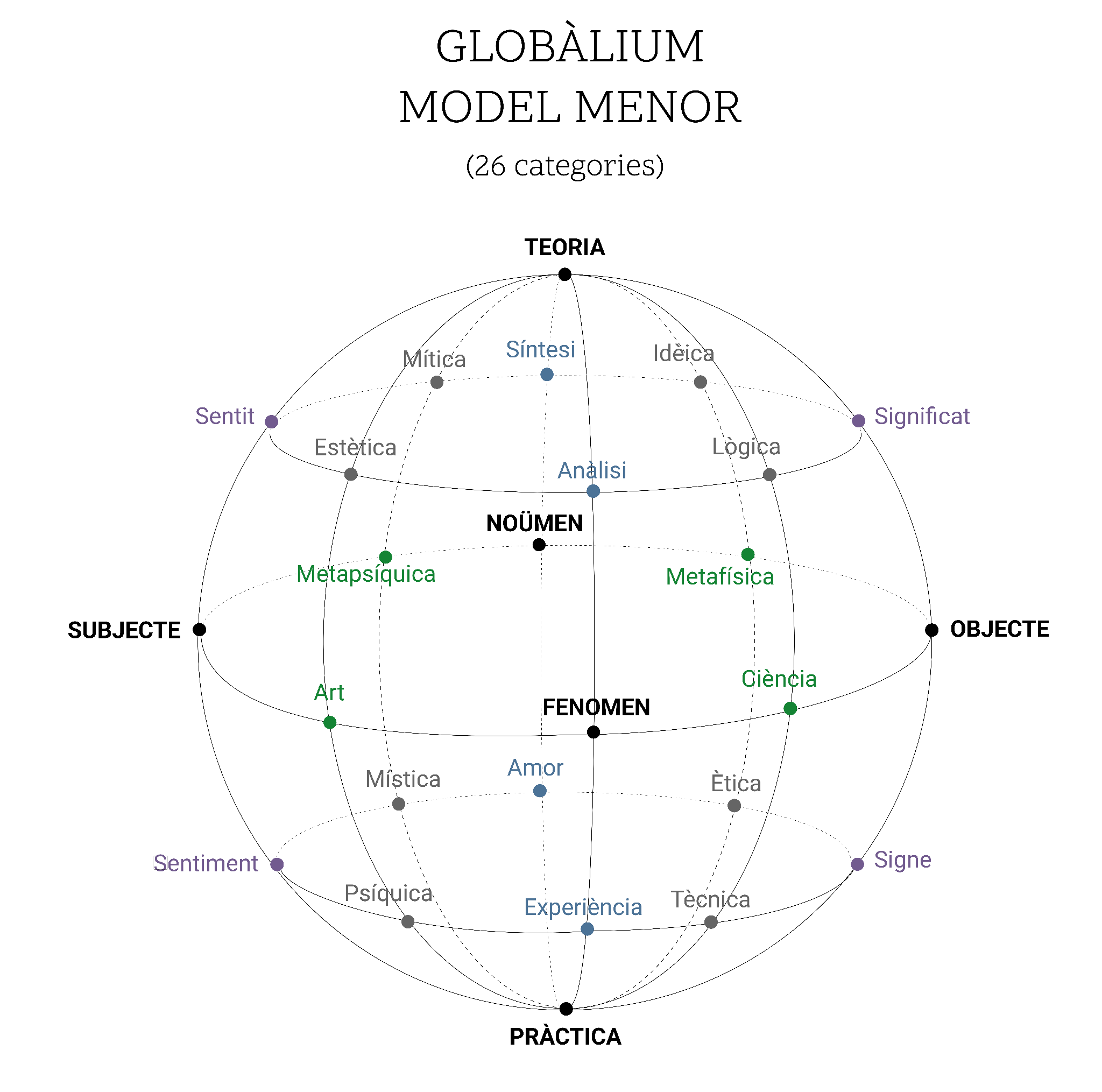
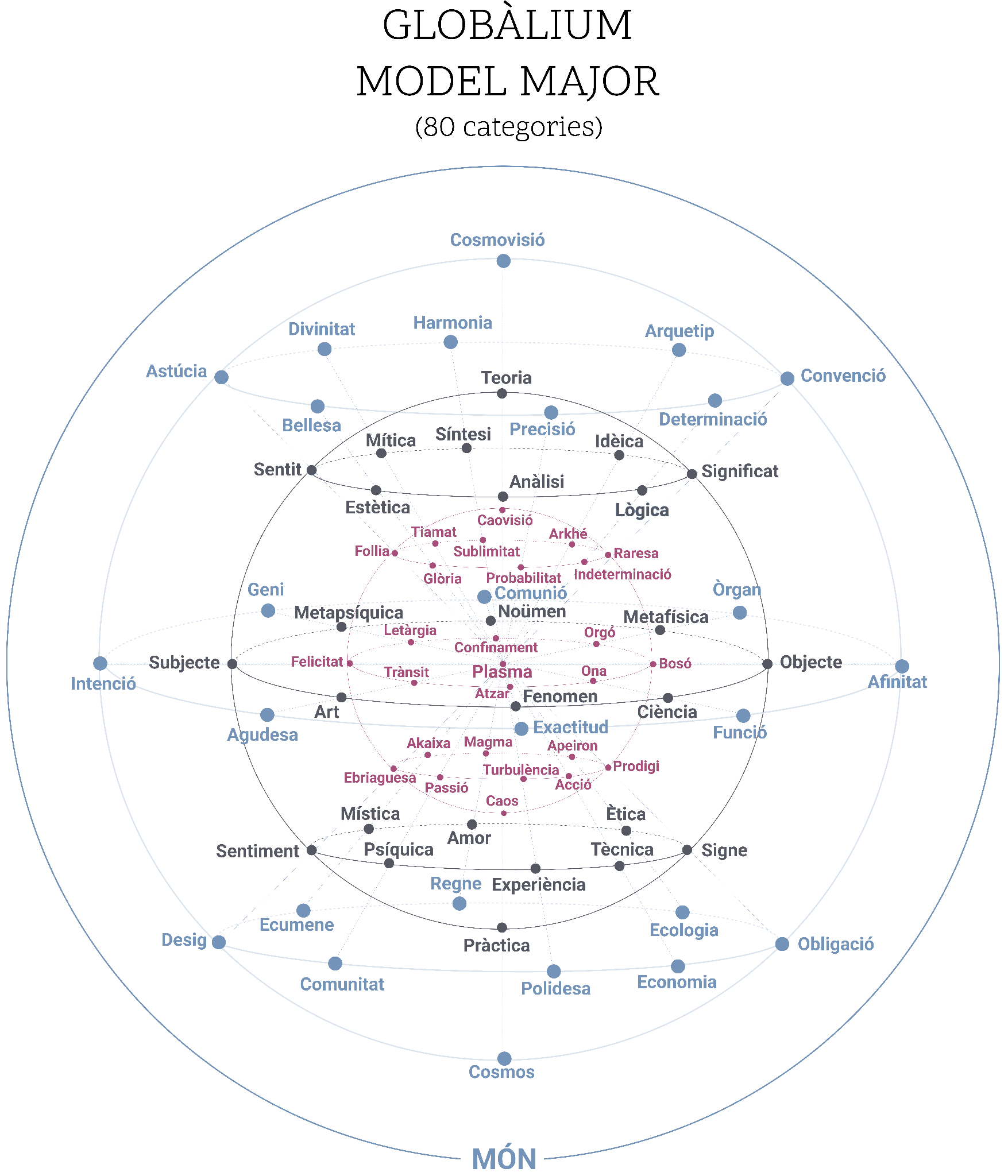
Fig. 3. Major Model 5
The major model can be understood as the union of 3 model layers: the neutral one, the plasmatic ones (in its interior) and the worldly ones (in its exterior). The following scheme shows the 3 layers of the model with their original abbreviations:
8. Dimensions
A dimension, in the Globàlium, is an axis connecting two opposite extremes — and everything in between. A simple example: chocolate.

Xirinacs did the same with reality as a whole. He concluded that we need four dimensions to represent everything. These dimensions are dualities — the very pulse of reality: a dance in which the extremes complement and need each other. The Globàlium lets us visualize them, so we can learn to balance them.
In the Globàlium, deficiency arises when a part swells or withers relative to the others — when harmonic balance is lost. For this very reason, any category can do good or harm: it depends on its development in relation to the rest. What heals us can, in excess, harm us. Virtue, then, lies in the harmonic balance between the parts.
Let us now see, one by one, the four dimensions with their two extremes.
PLASMA-WORLD dimension (surrounding)

PLASMA (PLA)
Origin and end (Alpha/Omega). Radical and fertile seed of reality. Minimal elemental reality. Germinal foundation or terminal destiny of reality. Fundamental particles. Genuineness. Originality. Cause. Inwardness. Core. Involution. Chaos. Rauxa (impulse). Negentropy. Heating. Contraction. Enfolding. Regenerating and creative source of reality.
Dangers: Involution, chaos, confusion, dissipation, instability, unpredictability.

WORLD (MON)
Maturation of reality. Fullness of time. Unfolding. Evolution. Order. Seny (good sense). Emergent reality. Effect. Expansion of the universe. Exterior. Syntropy. Entropy. Complexity. Cooling. Expansion. Progress. Abundance. Bearing fruit. Worldly.
Dangers: Normalism, boredom, stagnation, punishment, final judgement.
|
PHENOMENON-NOUMENON dimension (appearance)

PHENOMENON (FEN)
Apparent reality. Extrinsic. Apparent. Superficial. Ephemeral. Temporal. Tangible. Manifestation. Visible. Known. Form. Facts we grasp through the senses. Event. Evidence. Expressions of Reality. Parts. Reductionism. Fragmentation. Multiplicity. Conflict. Diversity. Distinction. Division. Dispersion. Space, time, History. Market. Change. Sequentiality. Existence. Presence. Communication. Here and now. (The where and the when).
Between chance (ATZ) and exactness (EXC)
Dangers: Competitiveness. War, Dispersion, Fragmentation.

NOUMENON (NOU)
Reality in itself, independent of perceptions. Transcendent reality. Intrinsic. Hidden. Deep. Eternal. Timeless. Intangible. Invisible. Unknowable. Ineffable. Mystery. The beyond that is in fact the here-most. The all with the all. Unicity. Essential. Absolute. Unquantifiable. Unqualifiable. Immutable. Universal spirit. Fullness. Absence. Universal source. Principle and mother of all things. Deep peace. Perpetual void. The true usefulness of emptiness. Ground. (The why).
Between closure (confinement/CNF) and openness (communion/CMN)
Dangers: Dogmatism, absolutism, isolation, power.Observation: Some deny the noumenon because it can neither be perceived nor inferred. But it can be recognized by analogy and by a process of elimination against the phenomenon. Even if it does not exist as a physical phenomenon, it is much needed, and in this way we make it exist. It is the black box of reality where everything is recorded and where everything takes on meaning.
|
SUBJECT-OBJECT dimension (tension)

SUBJECT (SUB)
Individual or collective subject. Pure subjective lived experience. Pure self, stripped of marks of identity. Free observer attentive from its own centre. Freedom (to doubt everything and decide). Independence. Happy intention. Lived experience. Life. Insoluble enigma. Changing and contradictory self. Negation of one's own self. The act of deciding freely and facing the consequences. With the capacity to hold oneself. Person. Agent. I. We. You. They. (The who).
Between happiness (FEL) and intention (INT)
Dangers: Ego. Pride. Arrogance. Self-hatred. Suicide. Depression.

OBJECT (OBJ)
Structural reality, constant, identical to itself and coherent. Observed reality. The things of the world and our bonds with them and among them. Constructions. They may be physical objects, intangibles or ideas. Body. Thing. Extension. Pairing. Network. Weave. Structure. Physical space. (The what-for).
Between boson (BOS) and affinity (AFI)
Dangers: Deprivation of freedom. Dogmatism. Monotony.Reflection: The subject must detach and unfasten itself from the objects that limit its freedom in order to self-realize. From freedom, the subject must take responsibility. Objective structures are also indispensable for our harmonization with the reality that surrounds us.
| How to balance the Subject–Object duality? By questioning everything so as to decide our responsibilities in freedom. By combining self-knowledge with knowledge of the world around us. |
THEORY-PRACTICE dimension (discerning)

THEORY (TEO)
Discernment. Abstraction. Mentalized reality. Globality. Generality. Source of speculative knowledge. Understanding and vision of practical Reality. Virtualization. Mind. Thought. Homogeneous sets. Authority. Government. Culture. Civilization. Adult life. (The what).
Between chaos-vision (CAV) and cosmovision (COV)
Dangers: Inaction, authoritarianism, "not keeping one's feet on the ground", "living in the clouds".

PRACTICE (PRA)
Concern. Concrete, whole and dynamic reality. Force. Spontaneity. Resistance. Authenticity. Anarchy. Heterogeneous sets. Ingenuousness. Simplicity. Wildness. Pure pragmatics. Radicality. The experience of love. The people. Childhood/old age. Demotic. (The how).
Between chaos (CAS) and cosmos (COS)
Dangers: Possession, destruction, complication, repeating the same mistakes.
| How to balance the Theory–Practice duality? By reducing the gulf between what we know and what we do, connecting mind and body. By proceeding from love, enabling critical thinking and learning from experience. |
9. Categories
We have seen the 8 fundamental categories of the model: Plasma, World, Phenomenon, Noumenon, Subject, Object, Theory and Practice. The ones we describe below live between these — in the in-between spaces and on the surface — and make up the minor and the major model.
The 4 central intermediate categories
Complementary to THEORY:

ANALYSIS (ANA)
Discernment, separating in order to understand. Decomposition. Thinking. Questioning. Doubting. Differentiating. Sorting out. Comparing. Evaluating. Measuring.
from probability (PRB) ↔ precision (PCS)
unfolding → enfolding ←

SYNTHESIS (SIN)
Wisdom. Harmonizing. Assimilation. Concluding. Synthesizing. That which is essential or important, that binds everything together.
from sublimity (SLM) ↔ harmony (HAR)
unfolding → enfolding ←
Complementary to PRACTICE:

EXPERIENCE (EXP)
Experimentation. Lived experiences and apparent effects of acts. Doing things. Working and playing. Learning. The challenge of each concrete event.
from turbulence (TRB) ↔ politeness (POL)
unfolding → enfolding ←

LOVE (AMO)
Transcendent lived experiences and effects of acts. Letting everything come to be. Loving. Generating. Giving. The making-concrete of transcendence in a deep union. The small silent voice that speaks to the conscience along the way of non-violent action.
from magma (MGM) ↔ kingdom (RGN)
unfolding → enfolding ←
The 4 lateral intermediate categories
These four categories orient us and give stability to the Subject-Object and Theory-Practice relations.
Complementary to SUBJECT:

FEELING (STM)
Drive and vital force. The mettle of living that awakens within us. The subjective bodily signals of our interaction with practical reality.
from inebriation (EBR) ↔ desire (DSG)
unfolding → enfolding ←

SENSE (STT)
The subjective sense with which we intuit reality, fruit of our perspicacity, intelligence, lucidity, shrewdness, beliefs, grace or imagination.
from madness (FOL) ↔ cunning (AST)
unfolding → enfolding ←
Observation: The subject needs feeling and sense in order to develop its will. With this will, the subject moves on to intention.
Complementary to OBJECT:

SIGN (SGE)
These are the objective signals of practical reality. Things in themselves stripped of interpretations (this). The constant evidences. Symptoms, omens, marks, errors, successes.
from prodigy (PRD) ↔ obligation (OBL)
unfolding → enfolding ←

MEANING (SGT)
It is the commonly agreed meaning we give to signs. Accepted definitions of objects. Reasons. Agreement. Common interpretation. Common sense. Terms, codes.
from rarity (RAR) ↔ convention (CNV)
unfolding → enfolding ←
Observation: To understand objective reality one must attend to the signs and discover their meaning, which turns them into useful objects.
The 12 disciplines
The twelve disciplines6 are part of reality and of ourselves. Recognizing them as integral parts of us is the first step in learning to develop them.
Adjacent to PHENOMENON,

SCIENCE (CIE)
Objective treatment of phenomena. A reductionist, mechanistic, deductive method of acquiring knowledge. Description of procedure. Forecasting how phenomena work. Knowledge of the proven facts of reality.
from wave (ONA) ↔ function (FUN)
unfolding → enfolding ←
ART (ART)
Subjective treatment of phenomena. Subjective creations. A method of acquiring knowledge through subjective observation. Creative expression of lived experience. Perceptions through the senses.
from transit (TRS) ↔ acuity (AGU)
unfolding → enfolding ←
Observation: Art and science, the two ways of knowing phenomenal reality.
Adjacent to NOUMENON,

METAPHYSICS (MTF)
The intimate foundation of reality, inscrutable to mechanistic scientists. The deep cause and essence of objective reality, of nature. Organized and structured organism. A holistic, systemic, inductive method of acquiring knowledge.
from orgone (ORG) ↔ organism (OGN)
unfolding → enfolding ←

METAPSYCHICS (MTP)
The deep cause and soul of the being, the soul. Source of genius. Meditation. Lethargy. Rest. Inspiration. Premonitions. Clairvoyance. A transcendent, spiritual method of acquiring knowledge.
from lethargy (LET) ↔ genius (GEN)
unfolding → enfolding ←
Observation: These are the two ways of being conscious of noumenal reality.
Adjacent to ANALYSIS,

LOGIC (LOG)
Objective logical assessment. Rules of reason. Deduction. Non-contradictory formal expressions. Formula. Language. Programming. Planning. Strategy. Magnitudes. Quantity. Searching for or expressing meaning.
from indeterminacy (IDT) ↔ determination (DET)
unfolding → enfolding ←

AESTHETICS (EST)
Subjective formal assessment. Creativity, Imagination, Fantasy, Grace, Good humour. Figurations. Opinion. Play. Searching for or expressing sense. Quality.
from glory (GLO) ↔ beauty (BEL)
unfolding → enfolding ←
Observation: When we analyse a phenomenon or a theory, we can do so in either of two ways, with an aesthetic assessment or interpretation, or with a logical assessment.
Adjacent to SYNTHESIS,

IDEAICS (IDE)
Objective ideals that guide us, ideas, principles, concepts, models, archetypes, identities, cosmogonies, ideologies. Classifying, identifying.
from arche (ARK) ↔ archetype (ARQ)
unfolding → enfolding ←

MYTHICS (MIT)
Subjective ideals that guide us, values, myths, heroes, gods. They inspire faith and beliefs in us. Expression of the soul of the universe. Experiential archetypes. Charisma. First expression of reality.
from tiamat (TIA) ↔ divinity (DIV)
unfolding → enfolding ←
Adjacent to EXPERIENCE,

TECHNIQUE (TEC)
Procedures of physical usefulness. Procedure. Method. Conditions for using tools. Professional skill. Efficiency.
from action (ACC) ↔ economy (ECN)
unfolding → enfolding ←

PSYCHICS (PSI)
Subjective lived experiences arising from experience. Emotions. Inner world, non-mental. Sensibility. Apparent human interaction.
from passion (PAS) ↔ community (COM)
unfolding → enfolding ←
Observation: Experience expresses itself externally in actions or technical skills, or internally in the form of sensations, emotions and psychic lived experiences.
Adjacent to LOVE,

MYSTICISM (MIS)
Subjective application of love, transformed into a state of fluidity and connection, trust. Surrender. Marvelling. Surprise. Letting go. Imperience (inner lived experience, the opposite of experience). The gift of being oneself. Intimate impulse. A state of channelling that carries us from emancipation to concord.
from akasha (AKA) ↔ ecumene (ECU)
unfolding → enfolding ←

ETHICS (ETI)
Objective application of love, transformed into the common good from ethical principles and values of coexistence. Rights and duties. Respect. Attitude. Immanence. End in itself. Mission.
from apeiron (APE) ↔ ecology (ECL)
unfolding → enfolding ←
Observation: Love expresses itself objectively in ethical actions (tough love, compelled by the demands of practical reality) and subjectively in the form of mystical imperience (soft love, in a state of intimate connection and fluidity).
Abbreviated definitions
Here is a list of short definitions to make consultation and memorization quicker.
Main:
PLA (Plasma): Origin and end (Alpha/Omega). Radical seed of Reality.
MON (World): Unfolded and mature reality. Fullness of time.
FEN (Phenomenon): the present moment; the here and now. Apparent reality.
NOU (Noumenon): transcendence. Universal spirit. Eternity. Unity.
TEO (Theory): mentalized and abstract reality. Understanding. Globality.
PRA (Practice): concrete and dynamic reality. Force. Authenticity.
SUB (Subject): pure self. Lived experience stripped of identity. Will. Collective.
OBJ (Object): constant and coherent structure. Body. Objective. Identity.
Neutral:
STM (Feeling): drive and vital force. Temperament. Bodily signals.
STT (Sense): the acuity with which we intuit and adapt to reality.
SGE (Sign): the thing in itself, stripped of interpretations. This. Signals.
SGT (Meaning): the commonly agreed truth we give to signs. Agreement.
EXP (Experience): Doing things. Learning. Experimentation.
ANA (Analysis): discerning. Critical judgement. Questioning. Thinking. Qualities.
ART (Art): perception and expression of lived experience. Creation. Senses.
CIE (Science): objective knowledge of facts, causes and effects.
TEC (Technique): action or skill that tends towards efficiency. Use of tools.
PSI (Psychics): inner experiential world. Emotions. Sensibility.
LOG (Logic): rules of reason. Non-contradictory formal expression.
EST (Aesthetics): free formal expression. Imagination. Play. Sense of humour.
AMO (Love): the making-concrete of the common good. Altruism. Generating. Giving. Loving.
SIN (Synthesis): that which is essential and binds everything together. Wisdom. Conclusion.
MTP (Metapsychics): essence of the subject. Soul. Consciousness.
MTF (Metaphysics): essence and cause of the object. Individual substance.
ETI (Ethics): the demands of practical reality as a whole. Rights and duties.
MIS (Mysticism): a state of channelling. The gift of being oneself. Marvelling.
IDE (Ideaics): structured principles that guide us. Conceptualizing. Ideating.
MIT (Mythics): subjective ideals that inspire faith in us. Myths. Charisma.
Plasmatic categories
The aim of this manual is not to delve deeply into each of the categories — for that, we recommend the thesis A Global Model of Reality. Even so, we offer an abbreviated description of the plasmatic categories so that you can get a general idea:
ATZ (Chance): chaos due to freedom. Unpredictable luck. Coincidence. → FEN
TRB (Turbulence): fertile disturbance of experience. → EXP
PRB (Probability): approximate discernment. Estimated distinction. → ANA
TRS (Transit): a state of sensory suspension/excitation. Inspiration. → ART
ONA (Wave): manifestation of the fundamental vibratory movement. → CIE
ACC (Action): movement produced by a force. Pure act. → TEC
PAS (Passion): radical expression of the spirit. Emotional agitation. → PSI
IDT (Indeterminacy): uncertainty. Approximate or null resolution. → LOG
GLO (Glory): the imaginary charm manifested by every successful thing. → EST
CAS (Chaos): fertile disorder. Enfolded universe. Revolution. → PRA
CAV (Chaos vision): deep mental confusion. Universal enigma. → TEO
FEL (Happiness): the subject's state of grace. Joy and sorrow. → SUB
BOS (Boson): the paradoxical structure proper to each object. Fusion. → OBJ
EBR (Inebriation): disturbance of the spirit through pleasure or pain. → STM
FOL (Madness): the mind beyond its limits. Absurdity. Folly. Impulse. → STT
PRD (Prodigy): a surprising feature or fact. Wonder. → SGE
RAR (Rarity): unconventional. Abnormal. Irregular. Scarce. → SGT
CNF (Confinement): isolation within a space defined by limits. → NOU
MGM (Magma): loving ebullition. Confined loving force. → AMO
SLM (Sublimity): revelation of perfection. Excellence. → SIN
LET (Lethargy): regenerating repose of the spirit. Sleep. Inert state. → MTP
ORG (Orgone): self-generating germ. Autopoiesis. Self-organization. → MTF
APE (Apeiron): basic undefined reality, without limits or law. → ETI
AKA (Akasha): a state of fluidity and surrender. Intimate impulse. → MIS
ARK (Arche): fundamental elements or principles. First causes. → IDE
TIA (Tiamat): the ancestral myth of the universal Mother. Providence. Faith. → MIT
Worldly categories
And here, the abbreviated description of the worldly categories. Notice how plasmatic and worldly complement each other — they run from one extreme to the other within the same neutral category.
EXC (Exactness): the inevitable rigour of facts here and now. FEN →
POL (Politeness): care. Tidiness. Mindfulness. Consideration. EXP →
PCS (Precision): meticulous discernment. Sharp distinction. ANA →
AGU (Acuity): perspicacity of the senses. Talent. Vivacity. ART →
FUN (Function): the phenomenological tasks of objects. CIE →
ECN (Economy): maximum efficiency with minimum effort. TEC →
COM (Community): intimate coexistence of people. PSI →
DET (Determination): sharp clarification of limits. LOG →
BEL (Beauty): appearance produced in accordance with an ideal. EST →
COS (Cosmos): worldly reality. Unfolded universe. PRA →
COV (Cosmovision): global abstract vision of reality. TEO →
INT (Intention): the subject's will. Attention on the purpose. SUB →
AFI (Affinity): mutual attraction that unites without confusing. Coherence. OBJ →
DSG (Desire): attachment to something or someone. Longing or enjoyment. STM →
AST (Cunning): the ability to see, or make others see, what suits one. STT →
OBL (Obligation): a bond that binds one to do something. SGE →
CNV (Convention): acceptance out of convenience. SGT →
CMN (Communion): maturation of transcendence. NOU →
RGN (Kingdom): earthly paradise. Realized utopia. AMO →
HAR (Harmony): fitting proportion and relation between things. SIN →
GEN (Genius): fertile spiritual ingenuity. Talent. Personality. MTP →
OGN (Organ): living being, born and self-built. Organism. MTF →
ECL (Ecology): sustainability. Responsibility. Solidarity. ETI →
ECU (Ecumene): the soul of the people. Common soul. Fraternity. MIS →
ARQ (Archetype): models and systems of reality. Rules. IDE →
DIV (Divinity): the ideal myths of persons or peoples. MIT →
10. Globalistic dialectics
Language is the subject's main tool: with it we articulate thoughts and become aware of reality. Human history can also be read as a history of languages — of how they have become more precise and more open. We are used to models of dialectics 0, 1 and 2; the Globàlium opens two more: 3 and 4 — and with them, new possibilities of language play. To internalize and apply the model, however, knowing its categories is not enough: one must learn the art of globalist dialectics.
Dialectics 0 — Adimensionality. A point. Dogmatic thought: a single, absolute and indisputable truth. No dialogue possible.
Dialectics 1 — One dimension. A line. Linear thought: discussion, direct confrontation, clash — the classic me or you.
Dialectics 2 — Two dimensions. A plane, where figures and circles fit. Flat thought: superficial, limited. It allows feedback, but lacks perspective and depth. Most current models are of this type, linear or flat — like an Excel sheet.
Dialectics 3 — Three dimensions. A space. It allows figures with diverse topologies. The Globàlium chooses the sphere — the simplest form in topology, considered perfect in classical philosophy and geometry for its inherent symmetry. It thus becomes a symbolic representation of globality: gentle and without edges, like a maternal womb. It lets us observe things from different angles, take distance, reflect — and at the same time see all the parts interconnected. (This is the minor model.)
Dialectics 4 — Four dimensions. The hypersphere. Global thought. The temporal dimension fits within it — and also the timeless: it lets us understand changes over time, make predictions, and identify the principles that always remain constant. It is the field of philosophical thought, of strategic planning, of systemic methods. (This is the major model.)
11. Turns
The original Globàlium thesis provided no method of application, but methods can be derived from its great circles. These circles make the model applicable — one of the aims of this manual. We call these turns revolutions because they make a complete loop around the model on an axis: they balance all the aspects of the categories they pass through, and can be traversed at the individual, collective and universal level. There are 3 more that pass through plasma-world, but we do not cover them in this introduction.
Turn of orientation (lateral meridian)
This turn serves to orient us: to know whether we are on the right track, by unveiling personal and contextual information, and aligning ourselves towards meaningful, transformative actions. We are oriented by signs, feelings, sense and meanings.
Route: PRA → STM → SUB → STT → TEO → SGT → OBJ → SGE → PRA
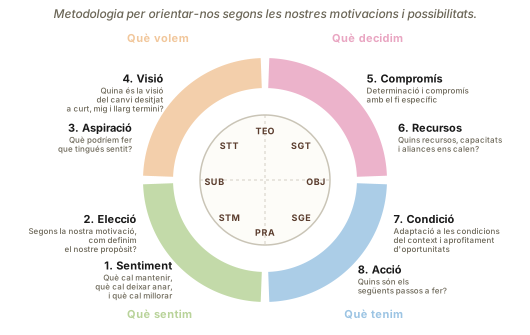
STAGE 1. (Desires). From PRA to SUB. What do we feel?
In this stage we must pay attention to what we feel and intuit. Every emotion, sensation and feeling reveals very valuable information to us, but its interpretation can be fatal. We must ask ourselves about the origin of our feelings, what triggers them and why, and be clear about what it is that we desire.
STAGE 2. (Aspirations). From SUB to TEO. What do we want?
In this stage we must ask ourselves what we do with this desire, decide whether it is legitimate and whether we set ourselves the purpose of achieving it. At this point it is we who govern over our feelings, and we must be able to have the freedom to decide what to do with them and to establish what our aspirations are.
STAGE 3. (Commitments). From PRA to SUB. What do we decide?
In this stage we must accept and reaffirm our commitment to a planned action. It is about staying firm in this decision until we carry it out. We will not always have the support of other people; the most important thing is that it makes sense to us and that we can make it possible.
STAGE 4. (Conditions). From PRA to SUB. What do we do?
In this final stage we will need to mobilize the necessary resources and ready ourselves with the most appropriate attitude to move into action. We will need to do so by adapting to the circumstances of our current context, seizing the opportunities that present themselves, and in an efficient and resolute way according to the strategic plan.
Turn of application (central meridian)
This is the turn of application or realization, for learning and carrying out actions sensibly, that is, justly and coherently both for ourselves and for others. For creating and applying method, reflecting and acting, thinking before acting, connecting mind and body.
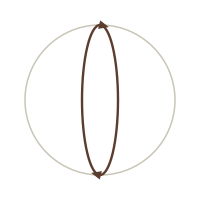
Route: FEN → ANA → TEO → SIN → NOU → AMO → PRA → EXP → FEN
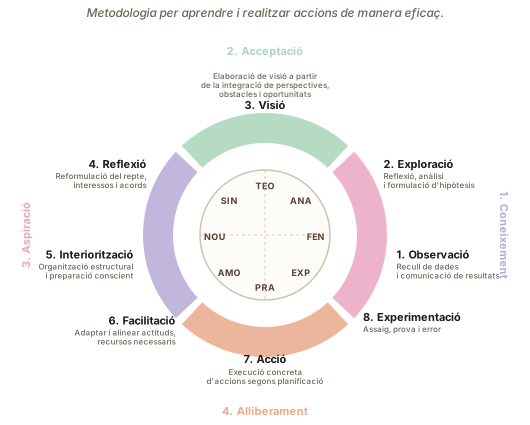
STAGE 1. (Know yourself). From FEN to TEO. Perception of ourselves and our surroundings
In this stage it is important to pay attention to what we do, to how we present ourselves, and to the environment we have. We must discern and obtain the information that gives us access to an objective view of the whole.
STAGE 2. (Accept yourself). From TEO to NOU. Appreciation of what we are and can be
In this stage we accept our limitations as well as our potentialities. It is important to be humble in order to accept reality here and now, but also to trust in our potential and possibilities. The evidence of our critical judgement must lead us to an assessment and to accepting it, even if we are not entirely sure.
STAGE 3. (Surpass yourself). From NOU to PRA. Bearing and attitude towards action
In this stage we identify how to resolve our limitations and what attitude we must adopt to ready ourselves for a fertile action. It is the stage in which it becomes crucial to know how to see ourselves and balance ourselves within the whole, overcoming the dualities.
STAGE 4. (Free yourself). From PRA to FEN. Acting and consolidation
In this stage our action will allow us to consolidate the results and free ourselves of what we wanted to do. Until we reach this point, and materialize the results in visible facts, we do not fully free ourselves.
Turn of knowledge (equator)
This turn serves to acquire self-knowledge and consciousness. To find the true object of the subject (the meaning of life), and to free the subject of what it does not need. It symbolizes the hero's journey or the archetypal path of any myth.
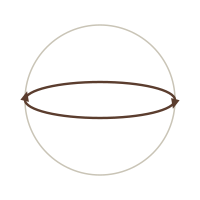
Route: FEN → ART → SUB → MTP → NOU → MTF → OBJ → CIE → FEN
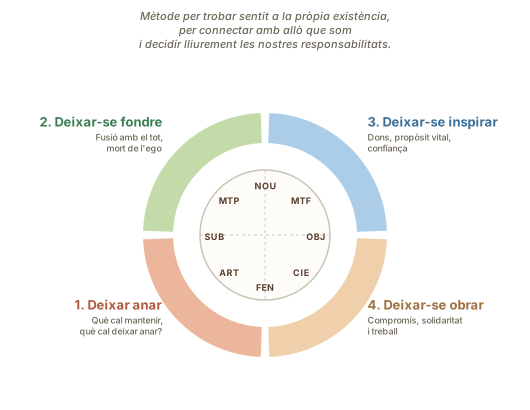
STAGE 1. (Letting go). From FEN to SUB. leaving the fruit and taking the seed
This is an ascetic stage that consists in letting go of all those attachments, fears, selfishnesses, materialisms and identities that somehow bind us and prevent us from being ourselves and walking our own path. It is a path on which we confront our ego (SUB), a journey towards our pure self. In this stage it is crucial to observe and interpret what surrounds us and what we feel, and to courageously let go of what limits us and we no longer need.
STAGE 2. (Letting yourself melt). From SUB to NOU. burying the seed
This is a dark stage of personal introspection. From here we must stop and adopt a disposition of openness, surrender and trust, embracing what we used to reject and letting ourselves humbly melt into the whole, in a state of receiving and offering. It is about crossing the dark night of the soul in order to live the mystical experience in which we experience that the whole is within us and that we are an intimate part of everything, and from which we become more conscious and can reach states of peace and gratitude.
STAGE 3. (Letting yourself be inspired). From NOU to OBJ. watering and waiting for it to be born
A stage of rebirth from the consciousness of being one with all and with everything. Listening for and discovering one's own gifts, vocation, function in society at the service of the common good as persons and as a people. Here the need comes into play to define the values, principles and needs or demands of practical necessity that allow you to organize yourself towards your particular mission.
STAGE 4. (Letting yourself act). From OBJ to FEN. tending it until it bears fruit
Carrying out your own vocation and mission. Letting yourself be worked by the universal spirit. The personal and collective realization that fullness bestows, the permanent banquet. Here the capacity to decide comes into play, in order to carry out a given function through actions and skills, and with responsibility, commitment and perseverance.
12. Learning guide
The Globàlium is a model for everyone and for all ages: it adapts to the level each person needs according to their stage of life. A first glance offers the general idea; but its real value appears when we internalize it and let it transform our gaze upon reality. Like everything, it asks for will, study and practice. In time we become globalists — a gaze that complements the specialist profile and widens its field. The Globàlium, once assimilated, is an update of our mental model: it changes the way we think and the way we act.
Learning levels
Level 1. Knowledge of the 8 main categories of the basic general model.
Challenge: to recognize the 4 dualities, identify their aids and limitations, and learn to balance them. A lifelong challenge — we never quite finish mastering it.Level 2. Knowledge of the 26 categories of the minor model.
Challenge: to discover the categories of the intersections — from which the main disciplines of knowledge emerge —, define them through relations of complementarity, and explore the application of the 3 great turns.Level 3. Knowledge of the 80 categories of the major model.
Challenge: to navigate the plasmatic and worldly categories, refine the art of globalist dialectics, and discover the creative play of good sense and impulse between plasma and world.Level 4. Knowledge of creating globalistic applications.
Challenge: to learn to apply the model in any field, generating one's own global worldviews and methodologies.
The 4 skills of the globalist
What are the skills of a good globalist? From the 4 principles of the model we can infer the 4 essential things one must learn:
Learning to situate within the model (To identify and understand)
→ from the principle of Identity.
Finding the places on the map. Each point is different.
Learning to relate categories (To dialogue and comprehend)
→ from the principle of Alterity.
Discovering the relations and learning to find balance. How some parts affect, condition and complement the others.
Learning to generate worldviews (To deepen and expand)
→ from the principle of Holicity.
Deepening into a concept and expanding it holistically, seeing its degree of representation in each part of the model.
Learning to create methodology (To decide and proceed)
→ from the principle of Universality.
Identifying and describing dynamics within the model that help us trace paths and attain our purposes.
How do I internalize the model?
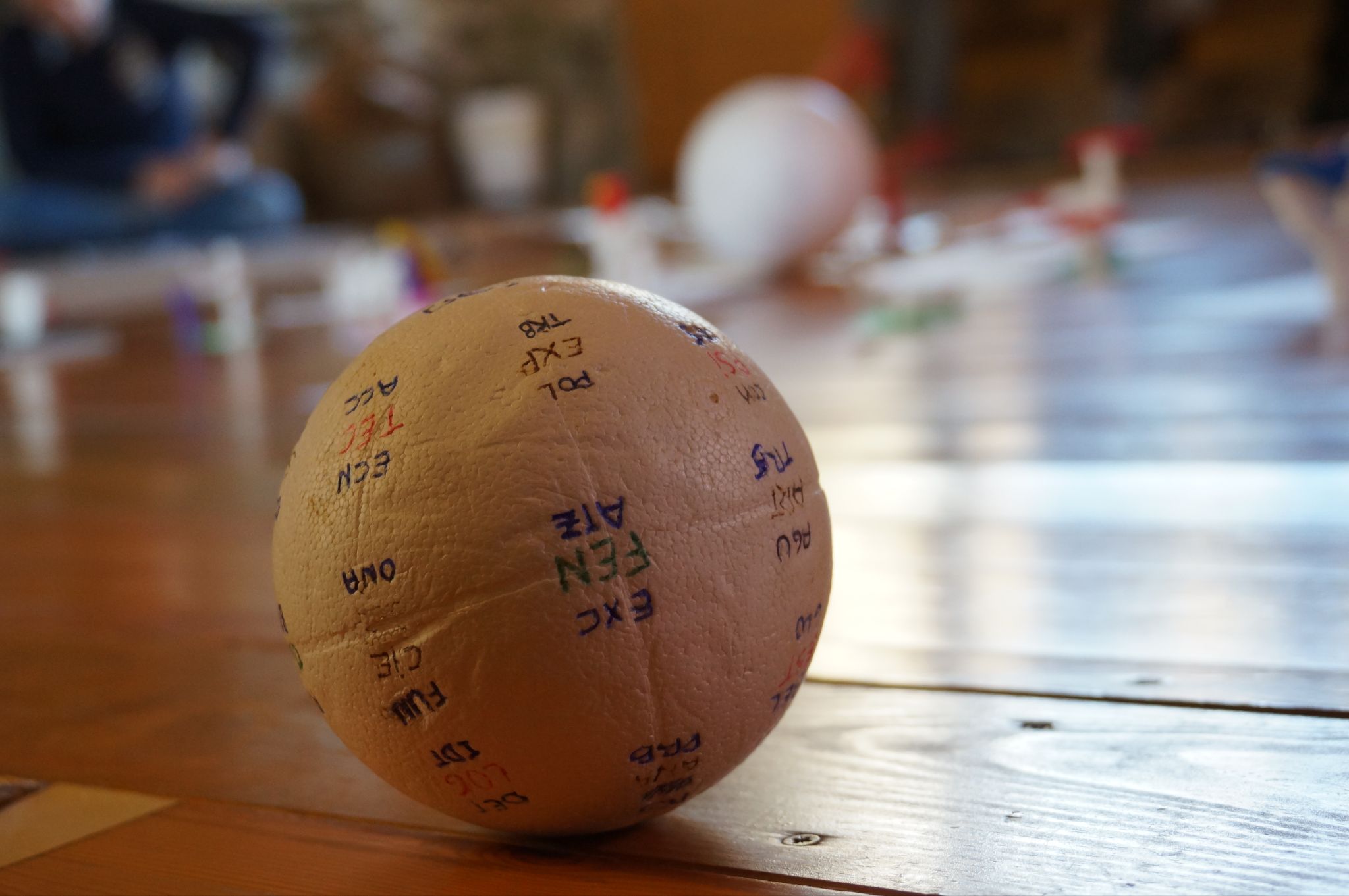
We recommend a polystyrene ball 12 cm in diameter on which you can paint the abbreviations of the categories of the minor model. Get used to looking at it from the Phenomenon, with the Theory oriented to the North pole — that way you will memorize it more easily. Once you have mastered the 26 categories, write the plasmatic ones in smaller letters below and the worldly ones above each of them.
An easy way to remember it with the body: Theory at the top (head), Practice at the bottom (body); the Phenomenon in front — grasped by the senses — and the Noumenon behind, the part we do not see. The Subject is to one side, tied to the creative hemisphere, and the Object to the other, tied to the rational one.
Mental gymnastics
We propose a few exercises — individual or collective — to do a little "mental gymnastics" with the Globàlium.
Exercise 1. Take the physical model and try to enumerate the categories mentally, without looking at it. Consult it when you get lost. Repeat until you can visualize it with your eyes closed.
Exercise 2. For each of the 8 main categories, think about how it helps us and how it limits us. Realize the importance of each part — and the need to balance them.
Exercise 3. Try to define any category of the model in terms of its neighbours. Then identify the complementarity with the categories situated at distance 2 or 4.
Exercise 4. Take words at random and try to situate them in the Globàlium. Notice that it depends on how you define them — and that there are multidimensional ideas that involve several categories at once.
Exercise 5. Choose a theme and develop its own globàlium — the thematic worldview — distributing its aspects across the categories of the model.
Exercise 6. Pose a conflict and represent the different points of view on the model. Understand where each one is looking from, identify the blind spots no one sees, and seek a path of understanding that all parties can accept.
Exercise 7. Think about which parts of the model you feel most represented by and which least. Ask yourself which mental territories you still have to explore to come closer to fullness.
Exercise 8. Pose a question to the Globàlium and discover the answers it offers you.
Coming soon: exercise sheets and didactic materials in card format.
13. References and links
Lluís Maria Xirinacs
Doctoral Thesis A Global Model of Reality: tesisenred.net/handle/10803/300309
Minor Model: lluismariaxirinacs.cat — minor model
Randa-Xirinacs Foundation
Website: xirinacs.cat
YouTube channel: @Fundacio.Randa-L.M.Xirinacs
Research group: xirinacs.wordpress.com
Vidabona Foundation
Globàlium workshops at Mas el Negre: elnegre.cat/activitats
Mas El Negre website: elnegre.cat
Opengea
Opengea SCCL website: opengea.org
Globàlium Telegram group: @globaliumcat
Globàlium short manual: data.opengea.org/recursos/globalium-petit-manual
Others
Figure and documentary archive of Lluís M. Xirinacs: lluismariaxirinacs.cat
14. Afterword — from the Globàlium to the Meta-Globàlium (2026)
This manual presents the Globàlium as Lluís Maria Xirinacs conceived it and as it has been developed at the Mas el Negre workshops. Since late 2024, the model has entered a new phase: the Meta-Globàlium —its computational revision and expansion— is proposed as the structural substrate of a neuro-symbolic, transparent and wise artificial intelligence.
The Arkadium project is its reference implementation. To learn more, see the manifesto at arkadium.ai/manifest/ and the academic paper at arkadium.ai/papers/arkadium/.
Knowledge is not a process in which partial data are accumulated into ever more complex organizations, but a process that also involves synthesis and the simplification of patterns.↩
We build mental reality according to the use we make of language, which means that we understand one another through confusion, since the meaning we give to words is subjective and contextual.↩
A path towards wisdom, where reality reveals itself as a complex yet harmonious fabric, in which all things have their just and meaningful place. It is a way of seeing the world that invites us to deep reflection and to action in consonance with the most fundamental values.↩
Through spherical geometry, we can conceive the ideas and categories of reality as points on this sphere, all connected and related, reflecting the interconnection and complexity of reality.↩
A four-dimensional hyperspherical model created by Xirinacs that integrates and represents, in a complete and multidimensional way, up to 80 fundamental categories, allowing a deep and holistic understanding of reality.↩
In this case, by discipline we mean a main area of study or branch of knowledge.↩